Showing posts with label history. Show all posts

Monday, August 17, 2009

The Life of Cola di Rienzo

The Life of Cola di Rienzo, translated by John Wright
Class: History 110- Medieval, Renaissance, and Reformation Europe

A bronze statue of a hooded man stands reaching his hands towards the air. This real life statue of Cola di Rienzo is located near the Campidoglio in Rome where he was killed. A skilled politician, the rise to the top ended with a sudden fall.

The son of an innkeeper and washerwoman, Cola di Rienzo was learned in Latin and the classical texts. He was able to read inscriptions around his hometown of Rome that others could not. In Cola’s Rome, nobles were corrupt and took advantage of the people, unlike the classical Rome that Cola studied. When Rienzo’s brother was murdered, Rienzo decided it was his duty to bring back the former glory of Rome. Elected by the people, Cola di Rienzo took up the old title of Tribune to govern over Rome and its inhabitants. Strict on the actions of the nobles, Rienzo was fast to make enemies. Even the Pope who first gave him favor later turned against him. Exiled from Rome, Rienzo lived with the Holy Roman Emperor in Prague, pretending to be a distant relative instead of the son of an innkeeper. Rienzo was able to win back favor after seven years and was welcomed back by being given the title of knight. However, with most political stories, success is short. A new agricultural tax is unpopular and the nobles are quick to turn the people against Cola di Rienzo. One failed escape attempt later, the nobles at the Campidoglio stab Rienzo to death where his statue now stands.

A pivotal figure in political history, Cola di Rienzo brought back the tradition of rule by election from the people instead of the popular monarchy. A true tale of power through ascension instead of descending rule, Cola is not the only fascinating character. I’m going to go out on a limb and call the narrator one fascinating dude. A notary, like Cola di Rienzo at the beginning of the tale, this author is also very well learned, taking breaks from the story to insert his own opinion as well as offer extra information by referencing classical texts such as the Bible or Aristotle. Aside from the knowledge of these characters, there are also some pretty cool battles. Feuding Roman families (also fighting for control of the papacy) have been fighting for centuries and are now becoming increasingly violent against each other, the lower classes, and of course Rienzo. There are many battles and riots with many deaths worth hearing about. Interesting, though, is that the narration is pretty dry except for descriptions of Cola’s clothes in two scenes, one when he becomes Tribune and another when he becomes Knight. I guess the physical description is enough to show that this is no longer the son of low birth but instead someone who claims rule for himself and claims false relations to an emperor.

A classic tale of rising and falling out of political favor is an interesting topic seeing that it happens almost every time we turn on the news. Its interesting to see that this Renaissance man had a similar story centuries early. The only difference today is that the nobles don’t kidnap a disliked politician to the Capitol building and stab him to death. They know better. The reading experience was fine if totally necessary, but I will let you know that I fell asleep twice; so beware.

I chose this quote because it was reading that spurred the lives of both of these men into action:
“Once you learn to read, you will be forever free.”
- Frederick Douglass

Monday, February 2, 2009

Everything is Illuminated

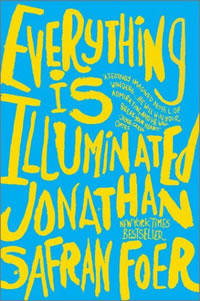
Everything Is Illuminated, by Jonathan Safran Foer

“A very good novel split into sections that go back and forth. One narrated by a Ukranian who cannot speak English very well, but it improves as he keeps studying. He works as a translator with his Grandfather for his father's touring business that allows tourists to find old places their ancestors once lived, etc. And he narrates the story of "the hero" and his search to find a woman who saved his grandfather in World War II. Other sections are the hero's writings of his own family history from a terrible wagon accident in a river by his very-great grandfather to the same river many years and generations after during the war. The other sections are letters as the two characters send their writings back and forth across the ocean and comment on each other's lives. It is a great novel that has you feeling for everyone in it, even "the bitch, Sammy Davis, Junior, Junior." (Shhh: One part made me cry.)”
[From Facebook’s “Caught Reading: Summer Project 2007”]

Although I cannot remember exactly which part made me cry, I do know that I am still in love with this book. The idea of a personalized tour through your own family history fascinates me. The Hero is trying to find the woman who saved his grandfather from the Nazis during World War II. However, his tour guides don’t come off as professional at first glance. Alex is a Ukranian obsessed with the club scene and still learning to speak English, which is an important fact since he is working as translator. It’s a family enterprise: Alex’s father owns the tour company, and Alex’s grandfather is the nearly blind van driver who is extremely protective of his “seeing eye bitch,” a horny dog named Sammy Davis Junior, Jr. As Alex leads the Hero through the countryside to learn more about family history, Alex is also getting closer to his grandfather. This story line is a very entertaining one, enough to make a movie starring Elijah Wood, but the movie leaves out my favorite parts. Intertwined with this narrative are the writings of the Hero about the story of his ancestors. While searching for the woman who saved his grandfather, the Hero writes the narrative of his family’s history leading up to the story of that grandfather. The historical excerpts from the city of Trachimbrod are all shocking, engaging, lovable, disturbing, and all together memorable. I just can’t get over the amazing love story of the Hero’s ancestors, but also the amusing workings of the tour group as they trace through the Ukranian countryside where millions of treasures lay buried in jars.

The amazing balance of detail and simplicity makes Foer’s writing accessible to all types of readers. The intricate plot that he weaves also makes it enjoyable for all. There is seriously something for everyone in this novel, and the writing style helps prove this. The author has a distinct style for the separate sections of this novel and because of this, I do not get confused by the plot jumps, and can keep reading and enjoying the journey.

Foer’s novel is a great search for knowledge that ends up illuminating more than what was originally sought after. When looking for a good read, you will definitely get more than expected from this work. And in a good way. That is the only way I can think to describe this book. I definitely recommend this novel for everyone! It will definitely stay with you. It is a must read before anyone can call themselves a “well-read person.”

“You know you've read a good book when you turn the last page and feel a little as if you have lost a friend.”
-Paul Sweeney