Monday, February 16, 2009

Diminished Capacity

Diminished Capacity, by Sherwood Kiraly


This book is a nice quick read that I finished in a two-day hardcore reading session. It is an easy read, but one of the most fun books I have read in a while. The characters alone would be enough to entertain you, but the things they have to go through together make it that much better. This is a fully enjoyable book.

When Cooper Zerbs has to deal with his Uncle Rollie, who has Alzheimer’s, going back to the small Missouri town where he grew up and moved out of makes the start of an interesting weekend. The pair joins up with Cooper's recently divorced high school girlfriend and her son to travel to Chicago to sell an extremely rare baseball card. The only thing is, an uncle with Alzheimer’s and a main character with a recent head injury are not the best pair to try and transport and sell a baseball card. Half the time they can't even remember where they last hid it to keep it safe. This card is a very valuable secret, which means that Uncle Rollie is constantly whipping it out to tell everyone, which leads to trouble with other card collectors in desperate times who hear about it, know its value and will do anything to try and get it away from the forgetful pair.

Like I said, the characters make this book. I don’t know how anyone could not be a fan of someone who sets up a typewriter on a dock with strings leading into the water so fish can write their poetry. A woman who agrees to drive with her son to Chicago because she is interested in selling a painting to a new chain of organic vegetable restaurants makes a perfect mate for the main character who is just as forgetful as the uncle he is trying to help. The desperate baseball memorabilia collectors at the convention show you how far one will go for your passion, no matter how odd. And when the silent boy ends up saving the day, you can’t help but feel proud. The characters are only one reason why this book is a must read. The plot is not very complicated, but as a reader you will still find yourself glued to the book until it is complete.

I would recommend this book to any reader looking for a quick fun read over a weekend or vacation or whatever, but I would especially recommend it to baseball lovers, any collector, and possibly to those who know or are related to someone affected by Alzheimer’s disease. You will leave this book smiling and possibly with sore sides from all that laughing.

“The man who does not read good books has no advantage over the man who can't read.”
- Mark Twain


This book was made into a movie starring Matthew Broderick, Alan Alda, Virginia Madsen, Dylan Baker and Bobby Cannavale. You will find the preview below for your viewing pleasure.

Monday, February 9, 2009

The Big House

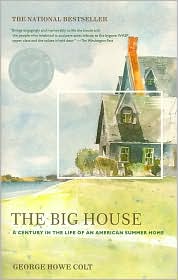
The Big House: A Century in the Life of an American Summer Home, by George Howe Colt

"This work of non-fiction definitely reads like non-fiction, but the story is just too amazing to put aside. The author decides to write a memoir when he is spending the last summer at The Big House before the family has to sell it. The stories he weaves together are all of his family's history linked to this summer home on the Cape. There are some dry chapters dedicated to the history of the Massachusetts area, but all in all you want to keep reading this fantastic family history of the Colt family. Having a regular place where I spend my summers, it linked me to the memoir even more. It recalls a once traditional way of life that is now drifting away to new things. I would recommend it to anyone with or without a summer place that can stand to pull through the non-fiction aspect of this piece of work."
[Facebook's "Still Reading (Summer 2008)"]

George Howe Colt, his wife and his daughter, are all heading to their family place on the Cape for one final visit before the house must be sold. While spending his last summer at the place where the majority of his childhood memories took place, the author tells readers not only about his life at The Big House, but also his entire family history that is wrapped up in the home. From the time it is built, to the constant renovations, to its final selling and the effort to repurchase it, Howe weaves an emotional ride. His tale involves family secrets uncovered through hard investigation, love affairs, madness, but also covers all of the things you would expect at a summer home such as sail boat races and tennis tournaments. It is interesting to learn about his family and notice how the traditional values and ways of life change over time. What used to be formal dinners and routines is now a bunch of crinkled fish tracings in the barn and a cracked tennis court. There are so many fascinating stories that I loved hearing about the previous Colt generations leading up to the author's own time spent at The Big House.
Yes, this piece is non-fiction, which means that there are some chapters devoted to the history of the area, mainly focusing on other houses built, and other historical families or events. I would say that the chapter about money was a downright bore, but the entire piece combined to leave you feeling like you got to know this family. Non-fiction does not mean that it reads like a history or chemistry textbook, it just means that it is more focused on story-telling than dialogue and complex character development. And Colt's writing is just as good to get the reader going and involved. There is a beautiful part near the end where the author spends the last night in the house alone during a hurricane that moved me, maybe not to tears, but definitely to moist, glossy eyes.
I think the fact that a writer can wrap up the majority of his family history by relating it back to a single object, a house, is enough to make me recommend this book. I do have a place I go to during the summer and I could totally relate to this book. The first few pages I read in the book store totally hooked me in because I knew exactly what he was talking about. However, even if you don't regularly visit a summer place, I would still recommend this book, either to find out what you are missing, or just to learn about the amazing generations of the Colt family and everything they have been through over time. It's a good read to be recommended to the right type of reader or summer home aficionado.

“When you sell a man a book you don't sell him just 12 ounces of paper and ink and glue - you sell him a whole new life.”
- Christopher Morley

Monday, February 2, 2009

Everything is Illuminated

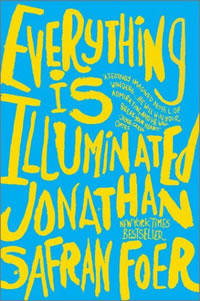
Everything Is Illuminated, by Jonathan Safran Foer

“A very good novel split into sections that go back and forth. One narrated by a Ukranian who cannot speak English very well, but it improves as he keeps studying. He works as a translator with his Grandfather for his father's touring business that allows tourists to find old places their ancestors once lived, etc. And he narrates the story of "the hero" and his search to find a woman who saved his grandfather in World War II. Other sections are the hero's writings of his own family history from a terrible wagon accident in a river by his very-great grandfather to the same river many years and generations after during the war. The other sections are letters as the two characters send their writings back and forth across the ocean and comment on each other's lives. It is a great novel that has you feeling for everyone in it, even "the bitch, Sammy Davis, Junior, Junior." (Shhh: One part made me cry.)”
[From Facebook’s “Caught Reading: Summer Project 2007”]

Although I cannot remember exactly which part made me cry, I do know that I am still in love with this book. The idea of a personalized tour through your own family history fascinates me. The Hero is trying to find the woman who saved his grandfather from the Nazis during World War II. However, his tour guides don’t come off as professional at first glance. Alex is a Ukranian obsessed with the club scene and still learning to speak English, which is an important fact since he is working as translator. It’s a family enterprise: Alex’s father owns the tour company, and Alex’s grandfather is the nearly blind van driver who is extremely protective of his “seeing eye bitch,” a horny dog named Sammy Davis Junior, Jr. As Alex leads the Hero through the countryside to learn more about family history, Alex is also getting closer to his grandfather. This story line is a very entertaining one, enough to make a movie starring Elijah Wood, but the movie leaves out my favorite parts. Intertwined with this narrative are the writings of the Hero about the story of his ancestors. While searching for the woman who saved his grandfather, the Hero writes the narrative of his family’s history leading up to the story of that grandfather. The historical excerpts from the city of Trachimbrod are all shocking, engaging, lovable, disturbing, and all together memorable. I just can’t get over the amazing love story of the Hero’s ancestors, but also the amusing workings of the tour group as they trace through the Ukranian countryside where millions of treasures lay buried in jars.

The amazing balance of detail and simplicity makes Foer’s writing accessible to all types of readers. The intricate plot that he weaves also makes it enjoyable for all. There is seriously something for everyone in this novel, and the writing style helps prove this. The author has a distinct style for the separate sections of this novel and because of this, I do not get confused by the plot jumps, and can keep reading and enjoying the journey.

Foer’s novel is a great search for knowledge that ends up illuminating more than what was originally sought after. When looking for a good read, you will definitely get more than expected from this work. And in a good way. That is the only way I can think to describe this book. I definitely recommend this novel for everyone! It will definitely stay with you. It is a must read before anyone can call themselves a “well-read person.”

“You know you've read a good book when you turn the last page and feel a little as if you have lost a friend.”
-Paul Sweeney

Monday, January 26, 2009

The Dante Club

So starting a book review blog during my busy junior year may have been a little too ambitious. However, even with the amount of coursework I have, I am determined to share my opinions of books for the masses, or at least the small amount of readers this blog gets. I will now be mixing in some “reviews” from previous Facebook reading projects, to make sure that every Monday will have something to offer.
This is from “Caught Reading: Summer Project 2007.”

The Dante Club, by Matthew Pearl

“An interesting historical fiction mystery that starts out a little rough but finishes strong. This book was very hard to get into since the first 50 pages were more or less for character analysis and laying the foundation for the rest of the novel, but once it gets into the mystery of it (and people start dieing), it keeps you at the edge of your seat. Four Boston writers in 1865 (Henry Wadsworth Longfellow, Oliver Wendell Holmes, James Russell Lowell, and J.T. Fields) are working on translating Dante's "Inferno" with much literary criticism from those who don't think Dante's writings are appropriate in proper society. But when multiple murders start occuring, the writers get swept into the mystery after discovering that the events are mimicking gruesome scenes taken directly from Dante's work. It is up to the intellectuals to save the day since they are the only ones capable of making any sense of it all. If you can struggle through the beginning of the novel (which I admit was hard) you will be rewarded for your efforts by going through the amazing and exciting process of finding a serial killer in historical Boston.”

I still think this book is a good one to share, which must say something about its quality. Personally, being an English major, I liked the literary aspects they were able to take to “epic” proportions. The beginning takes a while only because you need some time to understand the politics of the university administration and untangle a cast of seemingly similar professor characters. The action in this book is thrilling, and not what you would expect from older teachers. It is both physically and mentally active. The main characters stick to their passion of translating Dante even to the point of almost losing their jobs, but their work leads them to the cat-and-mouse chase of a mass murderer. They want to inspire others through this epic poem, but one character becomes far too inspired to the point of reenactment. Only those with literary knowledge are able to solve the mystery, which is inspiring to us English majors. But the best part is that you don’t have to be a literature expert to understand the novel or its references. The author gives readers the exact amount of knowledge needed about Dante’s work through the comprehensible dialogue that also helps readers just feel smart for knowing anything about Dante.

I think it says enough that I have chosen to re-share this book; I would definitely recommend it to any book lover who just likes to know that someday everything they read will help pay off. Maybe not to the point of catching a murderer, but I hope all this reading will help mold me into a cultured individual… someday.

“A capacity and taste for reading gives access to whatever has already been discovered by others.”
- Abraham Lincoln